I'm starting set of posts about what you can do with HDS.
First will be Consumption Current History.
This option you have on new cars.
Why should you care about consumption history?
This information is measured periodically by ECU when ignition is off.
Theory of operation (skip if not interested).
On Honda, we got Bosch EBS sensor (part-num 38920-TR0-A01) on negative terminal of the battery.
One method of reliably determining the battery charge level is provided by the Bosch Electronic Battery Sensor (EBS), a key component of the energy management system. Installed in the battery pole niche, it dynamically records the battery parameters of current, voltage and temperature with the utmost precision. The battery status recognition software integrated in the EBS uses these readings to determine the current and anticipated future status of the battery. In addition, the EBS offers advanced diagnostic functions during production, vehicle transportation and service operations. - from here
X-ray view of similar to Bosch sensor from Freescale (from here)
Interesting quotes from Freescale specs:
- Measurement range up to +/-2000A with an accuracy of 5 mA and a resolution of 1 mA
- Temperature Accuracy: +/-2°C (-20 to 60°C) and +/-3°C (-40 to 125°C)
This is how it looks on my car.
Sensor 38920-TR0-A016-M1, made in Hungary.
HW (hardware = board and components) version 06.02, SW (software) version 03.01.
Also, you can see production date on it 2013-02-04.
Say you have dashcam that works when engine is off. Should it drain your battery too much? You can end up in situation when you need to jump-start your car or even replace a battery if you not checked this things before (better) or after installation. Or you have other electronics connected.
Of course, you can do checks with DMM but now we have all data in ECU and it's more cool because it checks few times.
So, opening HDS
This is how my Civic is detected.
Main menu. Choosing Consumption Current History.
Little note what is about. Press Yes!
Next slide is first period.
When I turned ignition off, consumption was about 430 mA.
1 hour later that is my dashcam + security code staff + Honda's cunsumption.
2 hours - the same.
11 hours later my dashcam was switched off because I got a controller that monitors battery voltage and if it drops below setting (12V) it shuts off load - dashcam.
So 70 mA is car stuff. Not good actually, it shoul be around 20-40 mA. Need to check it.
Looks like it measures first 2 hours intervals and last one just before start, probably, when you inserted the key or opened the car.
UPDATE (2016-04-30)
Snapshot from manual mk9 Civic with original Israel's pass key secure and Blaupunkt New York 830.
Looks almost good. I would expect it to be around 30 mA. Probably local installs added ~20 mA.
ENDOF UPDATE
Bonus slide.
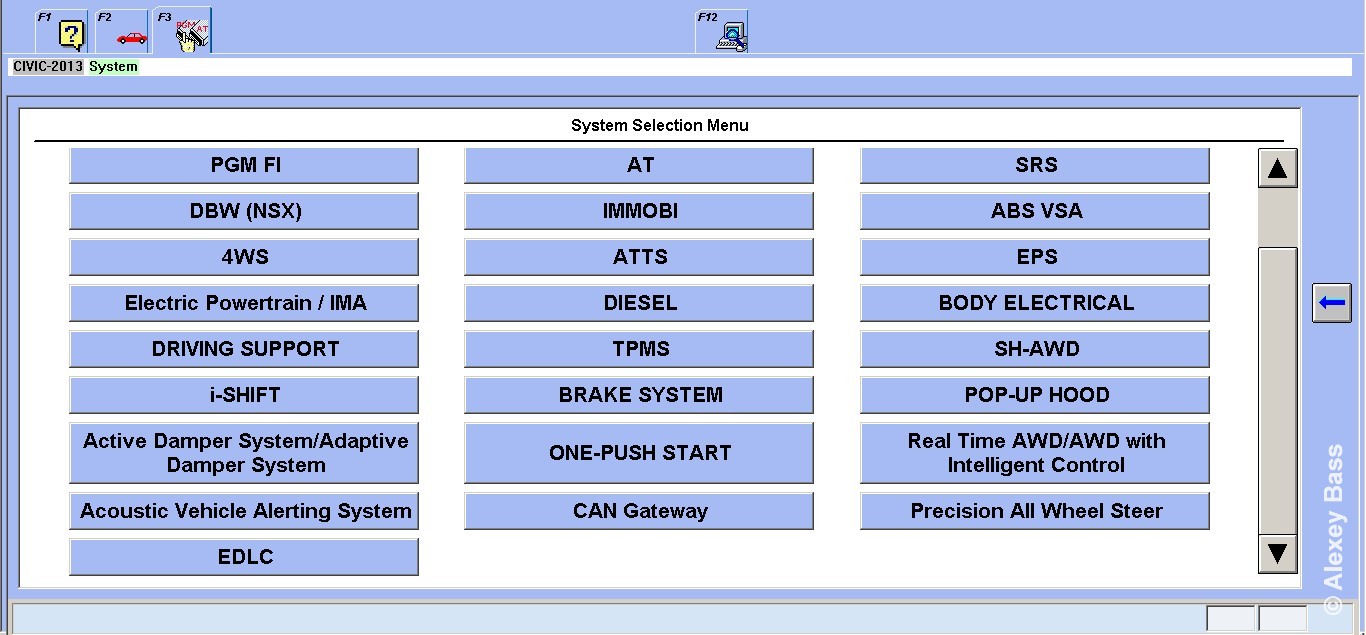
That is which modules you can access with HDS. Most of them available, but not all.
PGM FI - is Engine Control Unit (ECU), AT - transmission, SRS - airbags, and so on.. Stay tuned! ;-)
I heard a lot about oil consumption lately.
Anyway I wanted to endoscope cylinders long time ago but today I got good reason, recently I passed 30K mark. And it's always good to have reference.
I wouldn't recommend to bother checking spark plugs just for fun.
One common symptom that engine burn oil (normally it shouldn't, really, zero topping) is dirty blacky tail pipe. This is mine after 30K km.
It was funny, I got napkin in my hand and tried to swap something from there but it was clear, I checked again... I was very surprised :-)
Rust is the only thing that can be there if your engine not burning oil and fuel is good.
This is how can look engine with oil leak into the combustion chamber - black pipe inside, probably throwing some bluesh smoke at start. Depends...
VW Golf GTI
So... I was exited to look into mine engine.
First, you need tools:
1. 10mm hex for coil bolt.
2. 16mm hex with extender for spark plugs and torque meter (adapter like mine or wrehcn). Ratchet was missing (actually broken in my set), so I bought Kasco on the way to my work.
3. Other tools that was used are: magnet stick to get plugs out and in, brush for cleaning around.
Remove all coils, unplug connectors, remove bolts and pull gently coils up.
Important to keep area clean from any dust. You don't want particles to get into the chamber or between plug spacer and engine body. I used... plastic straw from IKEA :-) for blowing dust from there. Works perfect, don't forget to close plug hole with something when blowing out dust!
Coils made by Denso part number is 30520-R1A-A01, cost around $50 each on eBay.
Now, the plugs. First is form 1st cylinder, last from 4th.
Now more close. From 1st to 4th.
Awesome condition! Fuel is cool, no oil detected.
Few words about torque specs of plugs. NGK site says for thread size 12mm it should be 15-19 Nm.
When I unscrewed plugs, unscrewing torque was (measured by adapter):
1st - 29.0 Nm (~21.5 lbf-ft)
2nd - 19.2 Nm (~14.5 lbf-ft)
3rd - 32.1 Nm (~24 lbf-ft)
4th - 19.6 Nm (~14.5 lbf-ft)
Why they are differ? If you read this blog from the very first post, you can remember I checked few plugs already at Dec 2nd 2013. And master who did this tighten it back by hand. How people do that? Right, 3/4 turns after it make contact with the case. That's wrong! :-) You should always follow torque specs if possible, over spec and below spec can lead to bad plug job or even broken threads.
I tighten plugs with following specs: 20.5, 20.5, 20.1 and 20.7 Nm.
Bottom line. Engine feeling well.
Almost forgot... endoscoping video :-)
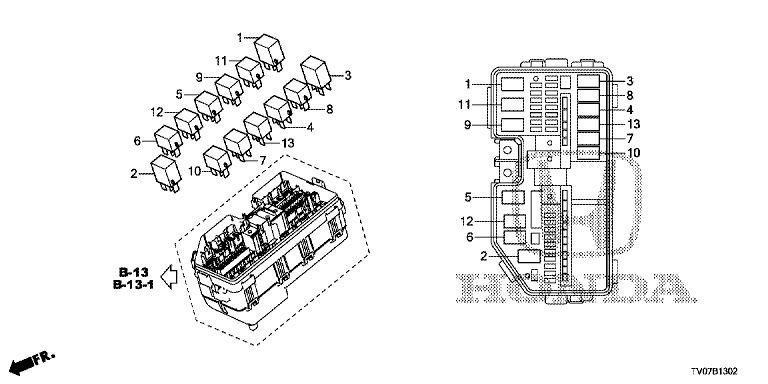
As soon I will install new horn set, I need to find relay.
Can't find good source of information about them, so I'll as usual try to summarize what I have.




.jpg)
.jpg)
.jpg)
.jpg)
.jpg)
.jpg)
.jpg)
.jpg)
.jpg)
.jpg)
.jpg)
.jpg)
.jpg)
.jpg)
.jpg)
.jpg)
.jpg)
.jpg)
.jpg)
%2Bdirty%2Bafter%2B15k%2B(1).jpg)
%2Bdirty%2Bafter%2B15k%2B(2).jpg)
%2Bdirty%2Bafter%2B15k%2B(3).jpg)
%2Bdirty%2Bafter%2B15k%2B(4).jpg)
.jpg)
.jpg)
.jpg)
.jpg)
.jpg)
.jpg)